
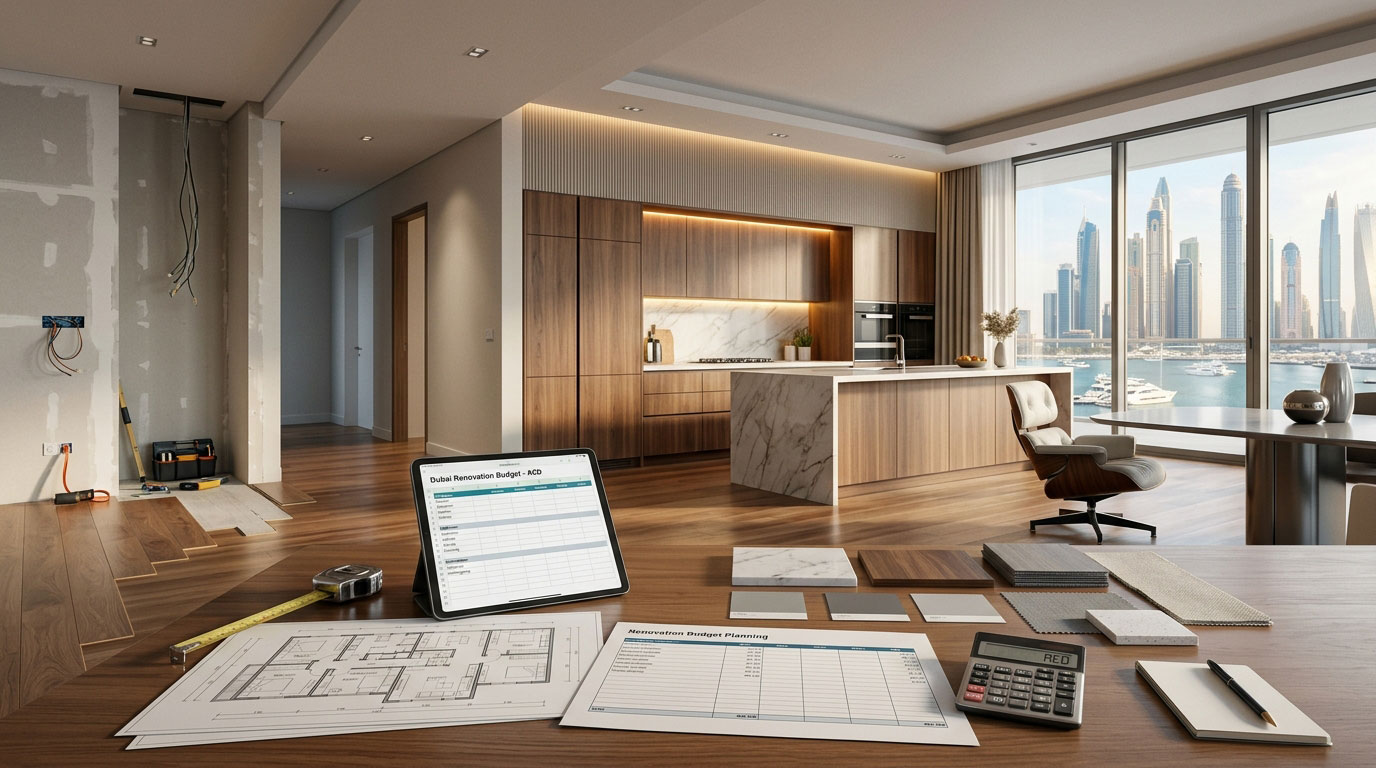
Home Renovation Budget Planning: How to Set (and Stick to) a Realistic Budget in Dubai
Every renovation conversation I have with a homeowner in Dubai starts the same way: “What’s this going to cost me?” It’s the right question — but it’s usually the wrong first step. A home renovation budget in Dubai that’s built well from the start is the single biggest factor in whether a project finishes on time, on scope, and without arguments over money halfway through. I’ve watched projects with generous budgets fall apart because the money wasn’t structured properly, and I’ve seen modest budgets deliver great results because the homeowner planned every AED before the first hammer swung.
This guide walks through exactly how to build a renovation budget that survives contact with reality — not just “add 15% for surprises” advice, but the actual process: how to sequence your planning, how to split your money across categories, which costs get missed every single time, and how to keep a project from creeping past its number.
Why Most Renovation Budgets in Dubai Fall Apart
In my experience, budgets don’t fail because homeowners are careless with money. They fail because the budget was built backwards — a total figure was picked first, then work was fit around it, instead of pricing the actual scope and then deciding what’s affordable. The second common failure is treating contingency as optional. The third, and most expensive, is scope creep: a kitchen renovation quietly becomes a kitchen-plus-utility-room-plus-new-flooring renovation because decisions were made room by room instead of against a fixed plan.
A realistic renovation budget planning process in Dubai has to account for three things most first-time renovators underestimate: the cost of getting approvals before work can legally start, the likelihood of finding something behind a wall or under a floor that wasn’t in the original quote, and the fact that Dubai’s supply chain for imported finishes (tiles, sanitaryware, certain hardware) can shift pricing between the quote date and the order date.
Step 1: Lock the Scope Before You Price Anything
Before requesting a single quote, write down exactly what’s included and what isn’t. “Renovate the kitchen” is not a scope. “Replace all base and wall cabinetry, replace countertop with quartz, relocate the sink 40cm left, repaint walls and ceiling, keep existing flooring” is a scope. Every line item you leave vague becomes a line item a contractor prices conservatively — or worse, one that gets added as a “variation” once work has started, at a price you didn’t get to compare.
If you’re renovating a villa across multiple rooms, break the scope into a simple table: room, work type, keep/replace decision. This single document is what keeps your budget honest through the entire project.
Step 2: Get Itemized Quotes From at Least Three Contractors
A lump-sum number (“AED 85,000 for the kitchen”) tells you almost nothing. An itemized quote breaks the same number into demolition, materials by category, labor, MEP work, and finishing — which lets you compare like-for-like across contractors and spot where one quote is cutting corners (usually in material specification or number of coats/layers) to look cheaper on paper. Ask every contractor for the same format so the comparison is fair. This is also where you catch the biggest budget risk early: a suspiciously low quote almost always means either a lower-grade material spec or an expectation that “extras” will be billed later.
Step 3: Allocate Your Total Budget by Category
Once you have a realistic total (from real quotes, not a guess), split it deliberately rather than letting spend happen organically. A workable allocation for a full home renovation in Dubai looks roughly like this — adjust up or down depending on how much of your project is structural versus cosmetic:
| Category | Typical % of Budget | What It Covers |
|---|---|---|
| Structural & MEP | 25–35% | Wall changes, electrical, plumbing, AC rerouting |
| Kitchen & Bathrooms | 20–30% | Cabinetry, countertops, sanitaryware, fittings |
| Flooring & Tiling | 10–15% | Materials + installation across all rooms |
| Painting & Finishes | 8–12% | Walls, ceilings, gypsum, trim |
| Carpentry & Fit-Out | 8–12% | Wardrobes, joinery, custom units |
| Permits & Approvals | 2–5% | NOC, Dubai Municipality fees, drawings |
| Contingency | 10–15% | Reserved, untouched unless needed |
← Swipe to see full breakdown →
For older properties — anything past 15–20 years, or units that haven’t been touched since original handover — I’d push contingency to the higher end and structural/MEP allocation up too, since concealed wiring and plumbing issues are far more common than owners expect. A property in an established community like The Springs or Mirdif, for example, is far more likely to have original 1990s or early-2000s wiring behind the walls than a unit in a newer development like Tilal Al Ghaf or The Valley, and that difference should show up in how you weight your budget before work even starts.
Step 4: Build In Contingency as a Real Line, Not a Mental Note
This is the step people say they’ll do and then quietly skip. A contingency fund isn’t a rough percentage you remember later — it’s a specific AED figure, held aside from day one, that you don’t touch unless something genuinely unplanned comes up. On a AED 200,000 renovation with a 15% contingency, that’s AED 30,000 sitting untouched. That reserve is what turns “we found a corroded pipe behind the bathroom wall” from a budget crisis into a normal Tuesday.
For most full apartment renovations, 10–15% contingency is sufficient. For villas, gut renovations, or any project involving significant demolition of older structures, 15–20% is the more realistic number.
Step 5: Track Spend as You Go — Don’t Wait for the Final Invoice
Keep a simple running log (a spreadsheet is enough) that’s updated every time a payment milestone is hit or a variation is agreed. This does two things: it flags early if a category is running over before it eats into contingency unnecessarily, and it gives you a paper trail if there’s ever a dispute over what was agreed versus what was billed. Payment structures in Dubai renovation contracts are typically milestone-based (e.g., 30% on signing, 30% at midpoint, 30% near completion, 10% on final handover) — tie your tracking to these same milestones rather than reviewing spend only once a month, since by then a category can already be well past where it should be.
Budgeting Differently for Villas vs Apartments
Villa and apartment renovation budgets don’t just differ in total size — they differ in structure. A villa renovation typically carries a higher share of its budget in structural and MEP work, simply because villas have more exterior surface area, independent roofing, garden and boundary wall considerations, and often older or non-standard electrical layouts compared to apartments built to a developer’s unified specification. Apartment renovations, by contrast, usually carry a higher proportion of their budget in finishes and fit-out, since structural changes are more restricted by building regulations and shared-wall considerations, and NOC approval from the building or community developer is a bigger factor in the timeline than the Municipality process itself.
If you’re deciding between a villa and apartment renovation and want the fuller cost and timeline comparison, our Villa vs Apartment Renovation guide breaks down exactly where the money and time differ between the two property types.
A Worked Example: AED 150,000 Apartment Renovation Budget
Numbers make this easier to picture than percentages alone. Here’s how a AED 150,000 full apartment renovation budget in a community like JVC or Al Furjan might actually break down once it’s allocated by category rather than treated as one lump figure:
| Category | Allocation | Amount (AED) |
|---|---|---|
| Structural & MEP | 28% | 42,000 |
| Kitchen & Bathrooms | 25% | 37,500 |
| Flooring & Tiling | 12% | 18,000 |
| Painting & Finishes | 10% | 15,000 |
| Carpentry & Fit-Out | 10% | 15,000 |
| Permits & Approvals | 3% | 4,500 |
| Contingency (12%) | 12% | 18,000 |
← Swipe to see full breakdown →
Notice the contingency line: AED 18,000, sitting completely untouched unless something genuinely unplanned comes up — a corroded pipe, an electrical circuit that doesn’t meet current code, a structural crack behind old tiling. If nothing goes wrong, that reserve either stays banked or gets reallocated at the very end of the project toward a finishing upgrade you’d been considering, once every other category has already been settled. What it should never become is the default fund for scope changes decided mid-renovation — the moment contingency starts absorbing “let’s also redo the hallway” decisions, it stops protecting you from the surprises it was actually meant for.
A villa renovation follows the same logic at a larger scale, just with structural and MEP typically claiming a bigger share — often 35% or more once garden, boundary wall, or roofing work is involved, compared to the 25–30% more common in an apartment where those categories don’t exist at all.
Reviewing and Adjusting Your Budget Mid-Project
Even a well-built budget needs a checkpoint. I’d recommend a formal budget review at each payment milestone — not just glancing at the total, but checking each category against what’s actually been spent versus planned. If flooring is running 15% over at the midpoint, that’s the moment to decide whether to trim elsewhere or dip into contingency, rather than discovering it as a surprise at final handover when there’s no room left to adjust. This is also the right moment to revisit any “maybe later” items on your original scope list — if a category is tracking under budget, that’s often the best time to bring a deferred item back in, rather than adding it impulsively once work is already finished and the crew has moved on.
Hidden Costs Homeowners Forget to Budget For
These rarely appear in a contractor’s headline quote, and they catch almost every first-time renovator off guard:
Permit and NOC fees
Structural changes, MEP work, and external modifications typically require a No Objection Certificate from your building or community developer, plus Dubai Municipality approval where structural drawings are involved. Budget AED 500–10,000 depending on scope — apartment NOCs from developers like Emaar or Nakheel tend to sit at the lower end; structural villa work with certified engineering drawings sits higher.
Temporary accommodation
If the renovation covers your kitchen or bathrooms and you’re not able to live around the disruption, factor in the cost of staying elsewhere for part of the project. This is almost never included in a contractor’s quote, and for a full kitchen-and-bathroom renovation it can mean two to four weeks of alternative accommodation.
Waste removal and skip hire
Demolition debris has to go somewhere. Skip hire and waste removal typically runs AED 500–3,000 per load depending on volume — ask upfront whether it’s included in your quote or billed separately, since this is one of the most commonly excluded line items.
Material substitution costs
If a specified tile, fixture, or hardware item goes out of stock mid-project (common with imported finishes), you may need to substitute at a different price point. Agree a substitution policy with your contractor before work starts, not after a delay has already happened — ideally with a pre-approved list of equivalent alternatives at similar price points.
Financing Your Renovation
For larger projects, many homeowners in Dubai use a personal renovation loan rather than paying entirely from savings — most local banks offer these with fixed interest rates and terms typically ranging from one to five years. If you’re financing part of the project, build your contractor’s milestone payment schedule around your loan disbursement timeline so you’re never waiting on funds mid-project, which can otherwise stall work at exactly the wrong moment. This is a financing decision specific to your situation, so it’s worth a direct conversation with your bank rather than a generic recommendation here.
Budget Mistakes That Blow the Numbers
Changing scope mid-project
Deciding to also redo the hallway flooring once the kitchen crew is already on site feels efficient — but it almost always costs more than planning it in from the start, and it eats into your contingency reserve meant for genuine surprises rather than planned upgrades.
Choosing the lowest quote without checking specification
The cheapest quote is rarely the same job as the others. Compare material grade, number of coats, warranty terms, and what’s explicitly excluded — not just the bottom-line figure. A quote that’s 20% lower than the others usually means something was left out, not that the contractor found a better deal.
Skipping the contingency line entirely
The single most common reason Dubai renovations run over budget. Build it in from day one and don’t reallocate it to “nice to have” upgrades once the project is underway and the reserve is still sitting untouched.
Not accounting for VAT and delivery on materials
Quoted material prices don’t always clarify whether 5% VAT and delivery charges are included. On larger material line items — tiling, sanitaryware, custom joinery — this gap can add up to a meaningful percentage of the total if it’s assumed rather than confirmed.
How Vision Three Approaches Budget Planning
When we scope a renovation, we start with the same process outlined above — locking scope first, pricing by category, and being upfront about where contingency should sit based on the property’s age and condition. We provide itemized quotes broken down by category (not lump-sum figures), flag likely hidden costs during the site visit rather than after work starts, and structure payment milestones so you always know what you’re paying for and when. For a full breakdown of typical renovation costs in Dubai, see our Home Renovation Cost Guide, and for what to expect once work begins, our Home Renovation Process Guide walks through the full timeline from planning to handover.
Frequently Asked Questions
How much should I budget for a home renovation in Dubai?
A full apartment renovation typically ranges from AED 40,000–200,000 depending on size and finish level, while villa renovations can range from AED 150,000 to over AED 1 million for extensive or luxury upgrades. Always base your figure on itemized quotes for your specific scope rather than a generic average.
What percentage should I set aside for contingency?
10–15% is standard for most renovations. For older properties or projects involving significant demolition and MEP replacement, 15–20% is the safer allocation.
Do I need Dubai Municipality approval for a home renovation?
Yes, for structural changes, MEP work, and external modifications. Cosmetic-only work (painting, flooring replacement without layout changes) typically doesn’t require Municipality approval, though your building or community developer may still require an NOC. See our Renovation Permits & Regulations guide for full detail.
What’s the biggest hidden cost in a Dubai renovation budget?
Permit and NOC fees, temporary accommodation if you need to vacate, and waste removal are the three most commonly missed costs — none of these typically appear in a contractor’s headline quote.
Should I renovate my kitchen and bathroom first if my budget is limited?
Yes — kitchens and bathrooms consistently deliver the strongest return in terms of daily livability and resale or rental value, making them the priority when budget doesn’t stretch to a full-home renovation.
Can I get a loan for home renovation in Dubai?
Most UAE banks offer personal renovation loans with fixed interest rates and terms of one to five years. Speak with your bank directly to compare terms against your project timeline.
How do I stop a renovation from going over budget?
Lock your scope before pricing, get itemized (not lump-sum) quotes, hold a genuine 10–20% contingency untouched, and track spend against payment milestones rather than only reviewing costs at the end of the project.