
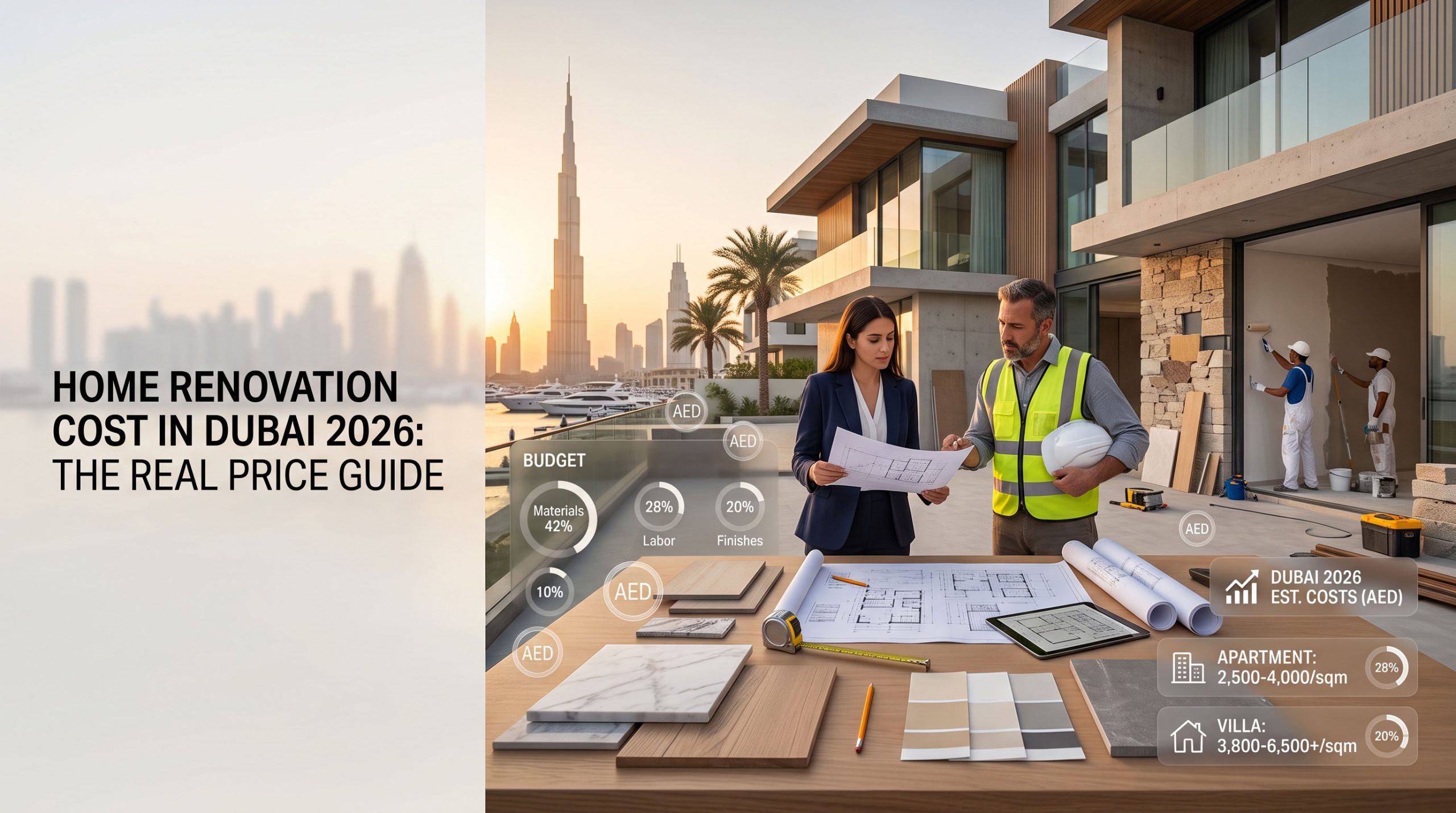
Home Renovation Cost in Dubai 2026: The Real Price Guide
Every renovation conversation in Dubai starts the same way. Someone sends us a floor plan, or a few photos of a tired villa in Arabian Ranches, and the first question is never about materials or timelines. It is always some version of: what is this going to cost me?
The frustrating part is that most homeowners have already collected three or four quotes by the time they call us, and the numbers are nowhere near each other. One contractor says AED 90,000 for the kitchen. The next says AED 240,000. Neither of them is necessarily lying. They have simply priced two completely different scopes, two different material grades, and two different levels of risk — and nobody explained that to the homeowner.
This guide is our attempt to fix that. Below is an honest breakdown of what home renovation actually costs in Dubai in 2026, where the money goes, what the approvals add, and which line items quietly get left out of cheap quotes. The figures reflect current market ranges across Dubai contractors, not a sales pitch. Use them to sanity-check whatever quote is sitting in your inbox.
The short answer: Home renovation in Dubai costs roughly AED 150 to AED 1,200 per square foot in 2026, depending on finish level and how much you disturb the existing MEP and structure. A mid-range 2-bedroom apartment renovation typically lands between AED 150,000 and AED 350,000. A full 4-bedroom villa renovation typically runs AED 400,000 to AED 1.5 million+. Kitchens and bathrooms absorb 50–60% of nearly every budget.
Renovation cost per square foot in Dubai (2026)
Cost per square foot is the fastest way to get a realistic budget before anyone visits your property. It is a planning number, not a quote — but it will tell you within about 20% whether the figure in your head is achievable.
| Renovation level | Cost per sq ft | What it covers |
|---|---|---|
| Cosmetic refresh | AED 150 – 300 | Painting, flooring laid over existing surfaces, fixture swaps, minor carpentry. No layout or MEP changes. |
| Mid-range renovation | AED 350 – 600 | New kitchen, full bathroom strip-outs, new flooring throughout, some MEP rerouting, new joinery. |
| Premium renovation | AED 600 – 900 | Imported stone, bespoke joinery, smart home integration, false ceilings with layered lighting, layout changes. |
| Luxury / gut and rebuild | AED 900 – 1,200+ | Full strip to shell, structural modification, designer specification, complete MEP replacement. |
← Swipe to see full comparison →
To use it: take your built-up area in square feet, multiply by the rate that matches the finish you actually want. A 2,800 sq ft villa at mid-range specification (AED 450/sq ft) comes to roughly AED 1.26 million if you are renovating every room. Renovating half the villa costs roughly half that. The mistake we see constantly is homeowners applying a premium rate to a cosmetic scope, panicking, and abandoning a project that was affordable all along.
One Dubai-specific quirk worth knowing: apartments cost more per square foot than villas at the same finish level. It sounds backwards, but tower work carries service-lift bookings, restricted working hours, protected common areas, longer material handling, and building management conditions that a villa in Mudon simply does not have. Expect a 15–25% premium on the same specification.
What a full home renovation costs by property type
Per-square-foot rates are useful for planning. Total project figures are what people actually budget against. Here is where most Dubai projects land in 2026.
Apartment renovation
- Studio / 1-bedroom refresh: AED 35,000 – 80,000
- 2-bedroom, mid-range: AED 150,000 – 350,000
- 3-bedroom, mid to high specification: AED 250,000 – 550,000
- Penthouse or luxury specification: AED 600,000 – 1.5 million+
Villa and townhouse renovation
- Townhouse cosmetic refresh: AED 90,000 – 180,000
- 3-bedroom villa, mid-range: AED 300,000 – 700,000
- 4–5 bedroom villa, full renovation: AED 600,000 – 1.5 million
- Large villa, luxury specification: AED 1.5 million – 3 million+
The spread inside each bracket is real and it is mostly about two things: how many wet areas you are touching, and whether you are moving walls. A 3-bedroom villa where you keep the kitchen and bathroom positions and simply upgrade finishes is a fundamentally cheaper project than the same villa where the kitchen moves to the other side of the house. The second version drags plumbing, drainage, electrical load and approvals into the scope, and each of those has a cost attached.
Room-by-room renovation costs in Dubai
If you are renovating in phases — which many owners sensibly do — these are the individual room budgets to work with.
Kitchen: AED 45,000 – 250,000
The single most expensive room in almost every project. A standard Dubai kitchen with quartz worktops, semi-handleless cabinetry and integrated appliances lands around AED 55,000 – 90,000. Custom joinery alone eats 35–45% of the kitchen budget, which is why the same footprint can double in price based on cabinet specification alone. Imported Italian kitchens with premium appliance packages run well past AED 200,000. See our kitchen renovation service for scope details.
Bathroom: AED 15,000 – 90,000 per bathroom
A cosmetic bathroom update — regrouting, new sanitaryware, mixers, mirror and lighting — starts around AED 15,000. A full strip-out with new waterproofing, new tiling, a rebuilt shower and quality fixtures runs AED 35,000 – 60,000. Master bathrooms with stone, niche lighting and glass enclosures reach AED 90,000 and beyond. Never let anyone talk you out of full waterproofing to save a few thousand dirhams; it is the most expensive corner anyone can cut in a Dubai bathroom. Details on our bathroom renovation service.
Flooring: AED 45 – 350 per sq ft installed
Porcelain tile sits at the affordable end, engineered wood mid-range, and natural marble at the top — with marble carrying additional cost for sealing, levelling and slower installation. Whether the existing floor comes up or gets laid over changes the number significantly. Removal, disposal and screed correction can add AED 25–40 per sq ft on their own.
Painting: AED 8,000 – 45,000 for a full home
The cheapest visible transformation in any renovation, and the one where preparation matters more than paint brand. We have written a full breakdown in our Dubai painting cost guide, including per-room and per-villa rates.
False ceilings and lighting: AED 45 – 120 per sq ft
Gypsum ceilings with cove lighting, spot layouts and bulkhead detailing. Priced per area covered, not per room, and the cost moves with how much lighting design sits inside it. Our false ceiling and gypsum work page covers the build types.
Joinery and wardrobes: AED 800 – 3,500 per linear metre
Built-in wardrobes, TV units, walk-in closets and entry consoles. Melamine finishes at the lower end, lacquered and veneered custom work at the top. This is a category where quality is genuinely visible after two years — cheap joinery in Dubai humidity does not age gracefully. See our carpentry and joinery services.
MEP works: AED 25,000 – 200,000+
Electrical rewiring, DB upgrades, plumbing reroutes, AC duct replacement and fan coil units. Largely invisible when finished, which is exactly why it gets underquoted. If your villa is fifteen years old and you are gutting it anyway, this is the moment to deal with it. Our MEP contracting page explains the scope.
Permits and approvals: the cost most quotes ignore
This is where Dubai renovation differs sharply from renovating anywhere else, and where inexperienced contractors get owners into trouble. Approvals are not optional paperwork. Work carried out without them can be stopped mid-project, fined, and in the worst cases ordered to be reversed at your expense.
What you may need, depending on scope and location:
- Developer or community NOC (Emaar, Nakheel, DAMAC, Meraas, building management): AED 2,000 – 5,000 plus a refundable security deposit typically between AED 5,000 and AED 20,000. Allow 1–3 weeks.
- Dubai Municipality or Trakhees permit for structural, MEP or layout changes: AED 3,000 – 18,000 depending on scope and whether consultant drawings are required. Allow 2–6 weeks.
- Licensed consultant drawings where the permit demands them: AED 12,000 – 25,000.
- DEWA approvals where electrical load or water connections change: AED 500 – 5,000, longer if a load assessment is triggered.
Two practical points from experience. First, Palm Jumeirah and other Nakheel areas sit under Trakhees, which runs as a separate approval track alongside the community NOC — budget the extra time. Second, a Municipality permit does not replace the community NOC. Both are required, and the sequence matters. Contractors who tell you approvals “are not needed for interior work” are describing purely cosmetic work, and the moment a wall or a drain point moves, that answer stops being true.
Realistically, budget 3–7% of your project value for approvals, drawings and deposits on anything beyond a cosmetic refresh.
Villa vs apartment renovation: what actually differs
| Factor | Villa renovation | Apartment renovation |
|---|---|---|
| Cost per sq ft | Lower at equivalent finish | 15–25% higher |
| Access and logistics | Direct access, on-site storage | Service lift booking, restricted hours |
| Approvals | Community NOC + DM/Trakhees | Building management NOC + DM where applicable |
| Scope range | Includes exterior, landscaping, pool | Interior only |
| Typical duration | 8–20 weeks | 4–12 weeks |
| Noise restrictions | Community quiet hours | Strict, often 9am–5pm weekdays only |
← Swipe to see full comparison →
If you are weighing up which property to renovate first, the practical read is that villas give you more control over programme, while apartments are faster to complete but less forgiving on scheduling. Full scope detail sits on our villa renovation and apartment renovation pages.
How long a renovation takes in Dubai
- Single bathroom: 2–3 weeks
- Kitchen only: 3–6 weeks (joinery lead time drives this, not site work)
- Apartment, cosmetic: 3–5 weeks
- Apartment, full renovation: 8–12 weeks
- Villa, mid-range: 10–16 weeks
- Villa, full gut and rebuild: 16–28 weeks
Add approval time on top — it runs before site work, not alongside it. A villa project quoted at “twelve weeks” that needs a Municipality permit is realistically a sixteen-to-eighteen week commitment from signature to handover. Summer, roughly June through September, tends to be quieter across Dubai contractors, which sometimes means better availability and sharper pricing.
Where budgets actually break
After enough projects you learn that overruns almost never come from the thing people worry about. They come from a short list of predictable items.
Scope creep mid-project. The single biggest cause. Walls are open, the site looks exciting, and adding “just one more thing” feels cheap in the moment. Ten small additions on a villa project routinely add AED 60,000–100,000.
What was hiding behind the tiles. Failed waterproofing, corroded pipework, sub-standard original electrical work. Older properties in established communities carry more of this. This is exactly what a contingency is for.
Material substitution. A quote that specifies “porcelain tile” without a grade or supplier is not a fixed price, it is a placeholder. Always get material specifications named in writing.
Excluded line items. Cheap quotes achieve their price by leaving things out. The usual absentees: debris removal and disposal, protection of existing finishes, final deep clean, snagging, approval fees, and MEP works assumed to be “existing to remain.”
Living costs during the works. If the property is unlivable for ten weeks, that is ten weeks of alternative accommodation. It belongs in the project budget even though no contractor lists it.
Our standing recommendation: hold 10–15% of your budget as contingency, and treat it as spent money you hope to get back rather than a bonus you are likely to keep.
How to compare renovation quotes properly
When three quotes differ by 200%, the problem is almost always that you are comparing three different projects. Before comparing prices, make every contractor quote the same scope on paper.
- Is demolition, debris removal and disposal included?
- Are material grades and brands named, or just categories?
- Are approvals, drawings and NOC fees inside the number or outside it?
- Is MEP work included, or assumed “existing to remain”?
- Who protects existing floors, lifts and common areas?
- Is the final clean and snagging period in the price?
- What is the payment schedule, and is it tied to completed stages rather than dates?
- Is the contractor DM-licensed, and can they show the trade licence?
The last one matters more in 2026 than it used to. Contractor registration and competence checks have tightened considerably, and hiring an unregistered contractor shifts the legal exposure onto you as the property owner — fines and stop-work orders included. A quote that is 30% cheaper than everyone else’s is usually telling you something about scope, licensing, or both.
How to reduce renovation cost without wrecking the result
There is a right way and a wrong way to save money on a Dubai renovation. The right way protects the things you cannot easily redo later.
- Keep wet areas where they are. Moving a kitchen or bathroom is the most expensive decision available to you. Upgrading them in place is dramatically cheaper and usually looks identical when finished.
- Spend on what you touch daily. Worktops, taps, door handles, flooring. Save on what nobody notices.
- Phase the project. Bathrooms this year, kitchen next. Slower, but it avoids financing costs and lets you live with each change.
- Use one contractor for everything. Coordinating separate tilers, electricians, plumbers and painters yourself looks cheaper on paper and reliably costs more in delays and rework.
- Never economise on waterproofing, electrical work, or joinery hardware. These are the three areas where cheap decisions come back within two years.
Frequently asked questions
How much does it cost to renovate a house in Dubai in 2026?
A full house renovation in Dubai costs between AED 150,000 and AED 1.5 million in 2026 for most projects, or roughly AED 150 to AED 1,200 per square foot depending on finish level. Mid-range 2-bedroom apartments typically run AED 150,000–350,000, while full 4-bedroom villa renovations usually land between AED 600,000 and AED 1.5 million.
What is the renovation cost per square foot in Dubai?
Renovation costs AED 150–300 per square foot for a cosmetic refresh, AED 350–600 for a mid-range renovation, AED 600–900 for premium work, and AED 900–1,200+ for a luxury gut-and-rebuild. Apartments sit 15–25% higher than villas at the same specification because of building access restrictions and logistics.
What is the most expensive part of a home renovation?
The kitchen, in almost every project. It typically absorbs 25–35% of a full home renovation budget, with custom joinery alone accounting for 35–45% of the kitchen cost. Bathrooms come second, followed by flooring across all rooms and built-in joinery.
Do I need a permit to renovate my home in Dubai?
Yes, for anything beyond purely cosmetic work. Painting, cabinet replacement and like-for-like tile changes are usually straightforward, but any structural change, MEP modification, or layout alteration requires a permit from Dubai Municipality or Trakhees, plus a developer or building management NOC. Both approvals are required — one does not replace the other.
How much do renovation permits cost in Dubai?
Community or developer NOCs cost AED 2,000–5,000 plus a refundable security deposit of AED 5,000–20,000. Dubai Municipality or Trakhees permits run AED 3,000–18,000 depending on scope, and consultant drawings where required add AED 12,000–25,000. Budget 3–7% of project value for approvals overall.
How long does a home renovation take in Dubai?
A single bathroom takes 2–3 weeks, a kitchen 3–6 weeks, a full apartment renovation 8–12 weeks, and a full villa renovation 10–28 weeks depending on scope. Approval timelines run before site work begins, so add 2–6 weeks for permitted projects.
Why do renovation quotes in Dubai vary so much?
Because contractors are usually pricing different scopes, not the same job at different margins. Differences in material grade, whether approvals and MEP works are included, debris removal, protection and snagging all move the number substantially. Standardise the scope in writing before comparing prices.
Is it cheaper to renovate a villa or an apartment?
Villas are cheaper per square foot at the same finish level, but larger overall, so total cost is usually higher. Apartments carry a 15–25% per-square-foot premium because of service lift bookings, restricted working hours, protection of common areas, and building management conditions.
How much contingency should I budget for a renovation?
Hold 10–15% of your total budget as contingency. Older properties and projects involving wet areas or original MEP systems should sit at the higher end, since concealed problems like failed waterproofing or corroded pipework only become visible once demolition begins.
Can I renovate my Dubai home in phases?
Yes, and it is often the smartest approach for owners who are living in the property. Bathrooms, kitchen and living areas can be sequenced across separate phases. The trade-off is repeated mobilisation costs and a longer overall timeline, but it avoids financing pressure and lets you adjust the plan as you go.
What should never be cut from a renovation budget?
Waterproofing, electrical work, and joinery hardware. These are concealed or high-use items where a cheap decision surfaces within two years and costs more to correct than it saved. Finishes can be downgraded and upgraded later; the systems behind them cannot without redoing the work.
Does Vision Three provide fixed-price renovation quotes?
Yes. After a site visit we issue an itemised quotation with named material specifications, approval costs stated separately, and a stage-linked payment schedule. Scope changes are priced and approved in writing before work proceeds, so the final figure matches what you signed.
Planning your renovation
The homeowners who end up happiest with their renovation are rarely the ones who spent the most. They are the ones who defined the scope properly before anyone picked up a tool, kept a sensible contingency, and worked with a contractor who told them the uncomfortable things early — that the approval will take five weeks, that the marble will need sealing, that moving the kitchen doubles the MEP scope.
If you are at the stage of turning a rough idea into a real budget, we are happy to walk the property with you and give you honest numbers, including the parts other quotes leave out. You can see our full scope on the home renovation services page, or explore interior design if you are still shaping the concept.
Get a Realistic Renovation Quote
Send us your floor plan or a few photos and we will give you an honest budget range before you commit to anything. Site visits across Dubai, itemised quotations, and approvals handled for you.