
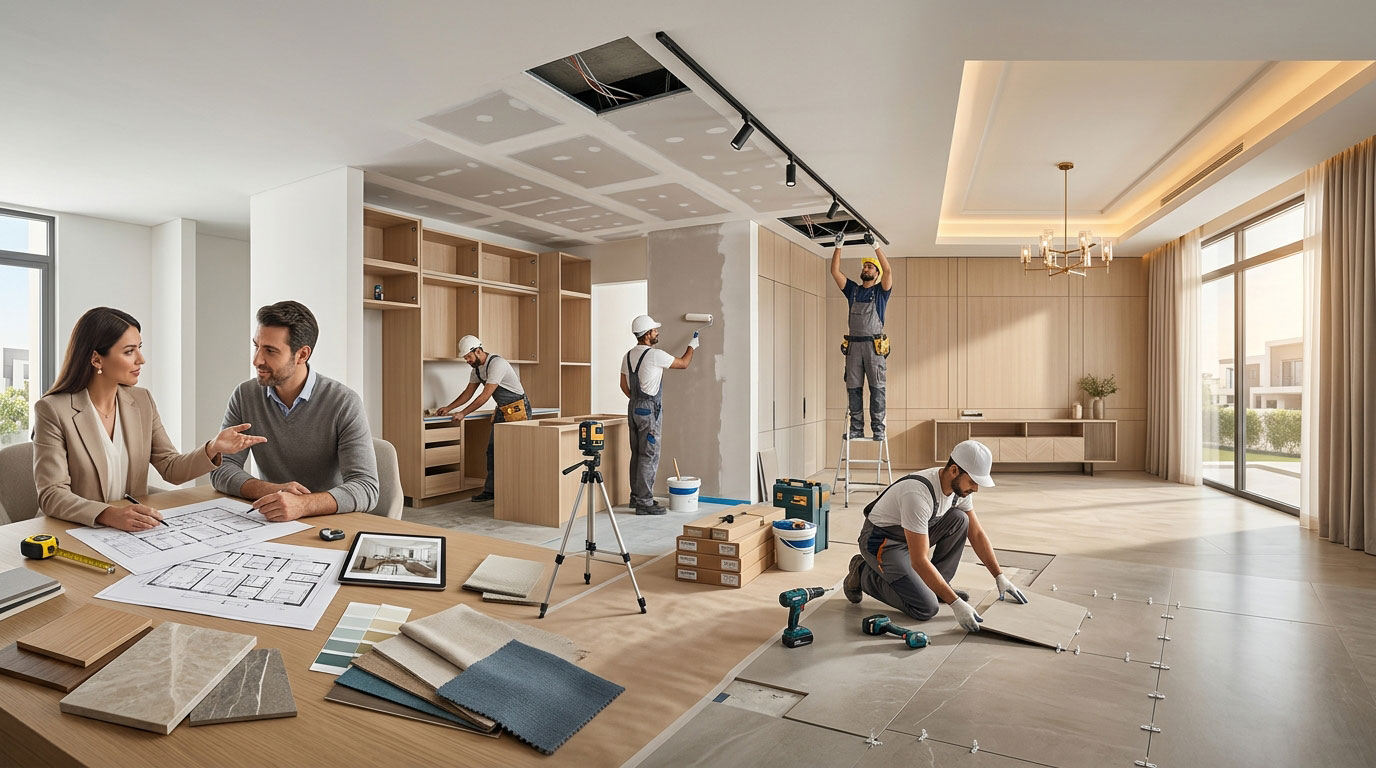
Home Renovation Process in Dubai: Complete Step-by-Step Guide (2026)
If you’re planning a home renovation in Dubai, the question that actually matters isn’t “how much will it cost” — it’s “what happens, in what order, and where do things typically go wrong.” We’ve covered renovation costs and permits and regulations in depth elsewhere. This guide is about the process itself: the five phases every Dubai home renovation moves through, roughly how long each one takes, and the specific decision points where a project either stays on track or starts sliding.
A standard apartment renovation in Dubai typically runs 8 to 16 weeks from signed contract to handover. A villa renovation, with more scope, more structural work and often outdoor elements, typically runs 3 to 6 months or longer. Those ranges hide a lot of moving parts — and understanding the parts is what actually lets you plan realistically instead of hoping for the best.
The Five Phases of a Dubai Home Renovation
Every renovation, regardless of scope, moves through the same five phases. Villas add more steps within each phase; apartments move through them faster. The phases themselves don’t change.
1. Planning & Design
Scope, layout and material decisions locked in before anything physical happens.
2. Approvals
NOCs and permits secured from your community, developer and Dubai Municipality or the relevant authority.
3. Demolition
Removal of what’s being replaced, and the point where hidden issues get discovered.
4. Construction
Structural, MEP and finishing work, in that sequence.
5. Snagging & Handover
Final inspection, defect list, and sign-off before you move back in.
What Counts as Major vs Minor Renovation Work
Not every renovation needs the full five-phase process at the same intensity. Understanding where your project sits helps set realistic expectations from the start.
Minor works — repainting, changing light fixtures, replacing cabinet fronts, cosmetic updates with no structural or MEP change — often move through approvals quickly, sometimes without a formal permit at all, though a community NOC may still apply. These projects compress the approvals and construction phases significantly.
Major works — moving or removing walls, changing electrical load, adding or relocating plumbing, altering built-up area — trigger the full permit process through Dubai Municipality, Trakhees or DDA depending on your property’s location, and follow the complete construction sequence: structural first, then MEP, then finishes. If you’re unsure which category your project falls into, this is worth confirming with your contractor or consultant before finalising a timeline, since it materially changes how long the approvals phase alone will take.
Phase 1: Planning & Design (2–4 Weeks)
The planning phase is where most renovation timelines are actually decided, long before any physical work starts. This is where scope gets defined, layout decisions get made, and materials get selected — and it’s also where an unclear brief causes the most expensive delays later.
The single biggest cause of mid-project delay is scope that isn’t actually locked before demolition begins. If you’re still deciding whether to move a wall, change a layout, or swap a material after work has started, the schedule doesn’t just pause — it often has to unwind and redo already-completed work.
Material lead time deserves attention here specifically. Imported tiles, stone countertops, custom joinery and specific fittings can carry lead times of 4 to 10 weeks. If a major material choice is made after demolition starts rather than before, the wait for that material can end up dictating your entire project timeline, regardless of how fast every other trade moves.
A proper planning phase also produces something concrete you can hold a contractor to: drawings, a material specification list, and a written scope of work. If any of these three things is missing or vague by the time demolition is scheduled, that’s a signal the planning phase hasn’t actually finished, whatever the calendar says.
Practical rule: lock your major material choices before demolition begins, not during construction. It feels slower at the planning stage. It’s dramatically faster overall.
Phase 2: Approvals & Permits (1–4 Weeks, Run in Parallel Where Possible)
Most renovation scopes in Dubai require some form of approval before work begins — a community or developer NOC at minimum, and a Dubai Municipality, Trakhees or DDA permit for anything involving structural changes, MEP modifications or a change in built-up area. Starting work without the required permit is not a grey area: authorities carry out site checks, and unpermitted work can mean a stop-work order, fines, or in serious cases a requirement to undo completed work entirely.
The practical detail worth knowing: which authority applies depends on where your property sits. Dubai Municipality handles most residential properties; Trakhees governs PCFC-controlled zones including parts of Palm Jumeirah and Dubai South; the Dubai Development Authority covers designated freehold and creative zones. Submitting to the wrong authority costs real weeks, not days.
We’ve covered this process in full detail, including specific timelines and costs by permit type, in our dedicated Renovation Permits & Regulations guide. The short version for this page: start your approvals process as early as possible, ideally in parallel with final design decisions, since permit timelines run independently of your contractor’s schedule and can become the actual bottleneck if left until construction is meant to start.
Seasonal Timing in Dubai Worth Planning Around
Two Dubai-specific timing factors are worth building into your planning phase, separate from the trade sequencing already covered.
Permit processing volume. October through April sees the heaviest volume of renovation permit applications in Dubai, as it coincides with the most comfortable months for construction work generally. Submitting during this period can mean longer approval queues purely from demand, not complexity. If your timeline has flexibility, submitting outside this peak window can shave time off the approvals phase.
Material delivery during summer. Imported materials routed through regional shipping can see minor delays during the hottest months, when logistics volumes and handling schedules shift. This is a secondary factor next to the lead-time planning already covered above, but worth an extra buffer if your renovation spans the summer period.
Phase 3: Demolition (Days to 1–2 Weeks)
Demolition is short relative to the rest of the project, but it’s the phase where hidden issues surface: water damage behind a wall, electrical wiring that doesn’t match the as-built drawings, plumbing routed differently than expected. This is normal, not a sign something has gone wrong — existing drawings for a Dubai property are rarely perfectly accurate, and demolition is often the first point anyone actually sees behind the finished surfaces.
What matters here is how a contractor handles what’s found. A genuine issue discovered during demolition should be documented, costed and confirmed with you before work continues, not absorbed silently into a larger invoice at the end. Ask how unexpected findings are handled before demolition starts, not after.
Phase 4: Construction (The Bulk of the Timeline)
Construction runs in a specific sequence for a reason: structural work first, then MEP (mechanical, electrical, plumbing), then finishes. Reversing this order — finishing a wall before confirming the electrical routing behind it, for example — is one of the most common causes of rework we see when brought in to fix another contractor’s project.
Structural and MEP first. Any wall changes, new openings or structural adjustments happen first, followed by electrical, plumbing and AC work while walls and ceilings are still open. This is also the point where inspections typically occur, confirming the MEP work meets code before it’s covered by finishes.
Finishes second. Flooring, wall finishes, painting, cabinetry and fixtures are installed once the structural and MEP work is confirmed and inspected. This is deliberately the longest visible phase, since it’s where a project starts looking finished, even though the less visible earlier work is what determines whether it functions properly for years afterward.
Coordination between trades matters more here than almost anywhere else in the project. A single contractor managing structural, MEP and finishing work directly can sequence this properly. Multiple separate contractors handling different trades without one party coordinating the handoffs is where scheduling conflicts and rework most often originate.
Inspection sign-off deserves specific attention within this phase. Once electrical and plumbing work is complete but before walls are closed up, this is the point to have any required inspection carried out, and to physically check the work yourself if you have any concerns. Once finishes go on top, verifying what’s behind them becomes a much bigger job than a five-minute look while everything is still open.
Phase 5: Snagging & Handover (3–7 Days)
Snagging is the final inspection before handover — walking the completed space, noting any defects (a door that doesn’t close flush, a paint touch-up needed, a fixture not quite level) and confirming they’re resolved before you sign off. This should happen as a formal walkthrough with a written list, not an informal “let us know if anything comes up” conversation.
A reasonable snagging period allows time for minor defects to be identified and fixed properly rather than rushed. Rushing this stage to hit a move-in date is a common source of post-handover frustration, where small issues that should have been caught and fixed during snagging instead become your problem to chase up weeks later.
Realistic Timelines by Property Type
These ranges assume approvals run in parallel with final design decisions, and materials are confirmed before demolition. Delays in either of those two areas extend every range below.
| Project Type | Planning & Approvals | Construction | Total Timeline |
|---|---|---|---|
| Apartment, single room refresh | 1–2 weeks | 2–4 weeks | 4–6 weeks |
| Apartment, full renovation | 2–3 weeks | 6–12 weeks | 8–16 weeks |
| Villa, kitchen or bathroom only | 2–3 weeks | 4–8 weeks | 6–11 weeks |
| Villa, full renovation | 3–4 weeks | 10–20 weeks | 3–6 months |
← Swipe to see full comparison →
One Contractor vs Multiple Contractors: What Actually Changes
This decision affects the process more than almost any other choice you’ll make.
Single Contractor, All Trades
One party sequences structural, MEP and finishing work directly, and is accountable for how the handoffs between phases are managed. Fewer coordination gaps, one point of contact if something needs adjusting.
Multiple Separate Contractors
Each trade managed independently, often by you personally coordinating the schedule between them. Can work with strong project management, but scheduling conflicts and unclear accountability for mistakes are the most common failure points.
How to Choose a Renovation Contractor
The contractor decision shapes every phase covered above more than any other single choice. A few concrete questions separate a contractor who will run this process properly from one who’s hoping it works out.
Ask whether they handle structural, MEP and finishing work directly, or subcontract each trade separately. Direct in-house coordination across trades is what prevents the sequencing failures described in the construction phase above. If every trade is a separate subcontractor with no single party accountable for the handoffs, ask specifically who manages that coordination.
Ask how they handle permits and approvals. A licensed, experienced contractor should be able to tell you immediately which authority applies to your property and roughly how long approval will take, not “we’ll figure that out once we start.”
Ask for a fixed quote, not a rough estimate. A detailed, itemised quote confirmed after a proper site survey protects both sides from scope disagreements later. A vague estimate given without seeing the property is a common precursor to cost creep.
Ask what happens if something unexpected is found during demolition. Their answer tells you a lot about how transparently the rest of the project will be run.
Mistakes That Extend Every Timeline
A handful of avoidable decisions account for most of the renovation delays we see, across every property type and scope.
Finalising materials after demolition starts. Once demolition begins, the clock on material lead times should already be running, not starting. A material choice made mid-construction can add weeks purely from shipping and stock availability.
Starting work before approvals are confirmed. A verbal “should be fine” from a contractor is not a permit. Confirmed written approval, not an assumption, is what protects the project from a stop-work order partway through.
Changing scope after demolition. A layout change decided after walls are already open often means undoing completed work, not just adding to what’s left.
No clear handoff plan between trades. Structural, MEP and finishing work need to be sequenced deliberately. Without one party coordinating that sequence, trades can arrive out of order or duplicate work already done.
Rushing snagging to hit a move-in date. A compressed snagging period trades a slightly earlier move-in for issues you’ll be chasing up for weeks afterward.
Home Renovation Process — FAQs
How long does a home renovation take in Dubai?
A standard apartment renovation typically takes 8 to 16 weeks from signed contract to handover. A villa renovation typically takes 3 to 6 months or longer, depending on scope. Both ranges assume approvals are confirmed and major materials are selected before demolition begins.
What are the five phases of a home renovation in Dubai?
Every renovation moves through planning and design, approvals and permits, demolition, construction (structural, MEP, then finishes), and snagging and handover. Villas add more steps within each phase; the phases themselves stay the same regardless of property type.
Do I need a permit to renovate my home in Dubai?
Most renovation scopes require at least a community or developer NOC, and structural changes, MEP modifications or a change in built-up area typically require a Dubai Municipality, Trakhees or DDA permit depending on where the property sits. Our dedicated Renovation Permits & Regulations guide covers this in full detail.
What causes the most delays in a Dubai renovation?
The most common causes are unclear scope that changes after demolition, material decisions made mid-construction rather than during planning, and starting work before approvals are formally confirmed. All three are avoidable with proper planning before physical work begins.
Should I hire one contractor or separate contractors for each trade?
A single contractor managing structural, MEP and finishing work directly can sequence the handoffs between phases properly, which is where most scheduling conflicts and rework originate when trades are managed separately. Multiple contractors can work with strong project management, but accountability for mistakes is less clear when something goes wrong between trades.
How far in advance should I select materials?
Major materials should be confirmed before demolition begins, not during construction. Imported tiles, stone countertops and custom joinery can carry lead times of four to ten weeks, and a late material decision can end up dictating your entire project timeline.
What happens if something unexpected is found during demolition?
This is common, since existing drawings for a Dubai property are rarely fully accurate. A reputable contractor documents and costs any unexpected issue and confirms it with you before continuing, rather than absorbing it silently into a later invoice.
What is snagging and how long does it take?
Snagging is the final inspection before handover, where defects are identified in a formal walkthrough and resolved before sign-off. It typically takes three to seven days and should not be rushed to meet a move-in date, since issues skipped at this stage become your problem to chase up afterward.
Can renovation work start before permits are approved?
No. Starting work without a confirmed permit is not a grey area in Dubai; authorities carry out site checks, and unpermitted work can result in a stop-work order, fines, or in serious cases a requirement to undo completed work.
Does a kitchen or bathroom-only renovation follow the same five phases?
Yes, the same five phases apply regardless of scope, just compressed. A villa kitchen or bathroom renovation typically takes six to eleven weeks total, following the same planning, approvals, demolition, construction and snagging sequence as a full renovation.
Planning a Renovation? Let’s Map Out Your Timeline
Send us your property type and rough scope, and we’ll give you a realistic phase-by-phase timeline before you commit to anything.
Related reading: Home Renovation Cost Guide · Renovation Permits & Regulations · Villa vs Apartment Renovation · Home Renovation Services · Carpentry Services