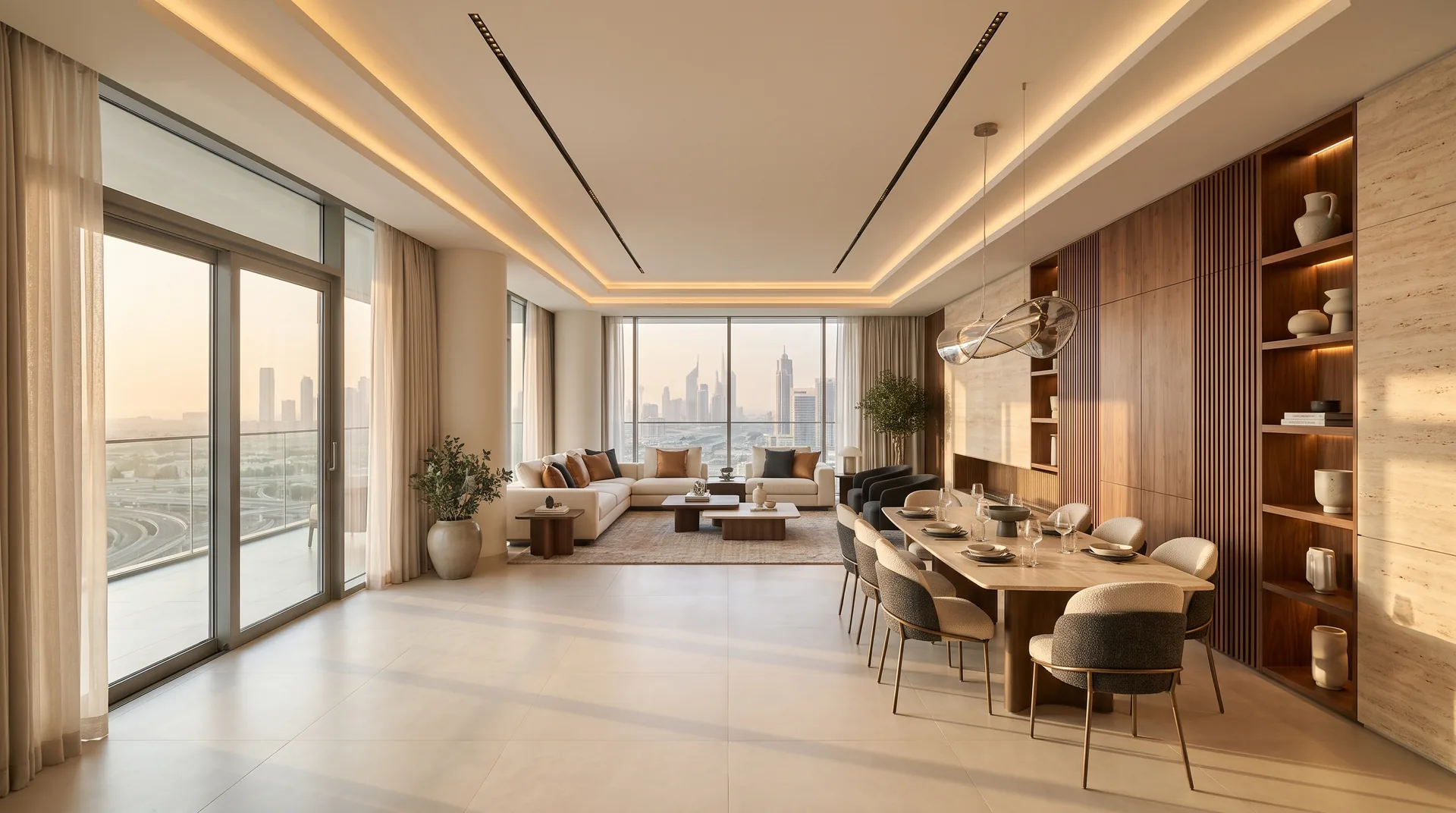
Short answer: the main interior fit-out trends in Dubai for 2026 are warm minimalism with natural stone, travertine and oak; fluted glass and fluted joinery; curved ceilings, walls and furniture; layered, integrated lighting such as cove and linear light; limewash and textured plaster instead of flat paint; full-height built-in storage; smart-home and lighting control; quieter, more acoustic interiors; hybrid offices with more meeting rooms and phone booths; and durable, low-maintenance finishes for rental homes. Most of them work best when planned at the fit-out stage, because they change ceilings, joinery and MEP, not just decoration.
Trends matter in a fit-out for one practical reason: a fit-out is expensive to change later. A colour can be repainted in a day; a ceiling, a stone floor or a wall of joinery stays for ten years or more. This guide explains the trends we see most often in Dubai homes and businesses in 2026, what each one involves in the fit-out, roughly what it does to the cost, and which ones will still look right in years to come.
At a glance
- Materials: travertine, natural stone, light oak and walnut, matt finishes, bronze accents.
- Forms: curves in ceilings, walls, counters and furniture.
- Texture: fluted glass and joinery, limewash and textured plaster.
- Light: cove, linear and concealed lighting, planned with the ceiling.
- Storage: full-height joinery, hidden storage, dressing rooms.
- Technology: smart lighting, AC zoning, data everywhere.
- Comfort: acoustics, fresh air, healthier finishes.
- Commercial: hybrid offices, experiential retail, open kitchens.
Trend 1: Warm Minimalism
The cool grey and high-gloss white interiors of the last decade have given way to warm, calm spaces: soft ivory walls, light stone floors, oak or walnut joinery, matt finishes and a few bronze or brushed-metal details. It looks simple, but it depends on precision, because there is nothing to hide a crooked joint or an uneven wall.
In the fit-out: level floors and walls, tight joints between ceilings, joinery and floors, recessed skirtings and concealed door frames. Cost effect: moderate; the materials need not be expensive, but the workmanship has to be good. Will it last? Yes. Warm neutrals and natural materials age well and suit both villas and apartments.
Trend 2: Travertine and Natural Stone
Travertine has become one of the defining materials of Dubai interiors, on feature walls, floors, staircases, vanities and reception desks. Natural stone more generally is replacing glossy porcelain in premium projects, often in large, calm slabs.
In the fit-out: stone needs the right substrate, fixing and sealing, and careful planning of joints and cuts. Large slabs need access through the building and lifts. Cost effect: higher than porcelain, especially for imported stone and large formats; stone-look porcelain gives a similar effect for less. Will it last? Yes, with sealing and care. See our flooring page for stone and porcelain options.
Trend 3: Fluted Glass and Fluted Joinery
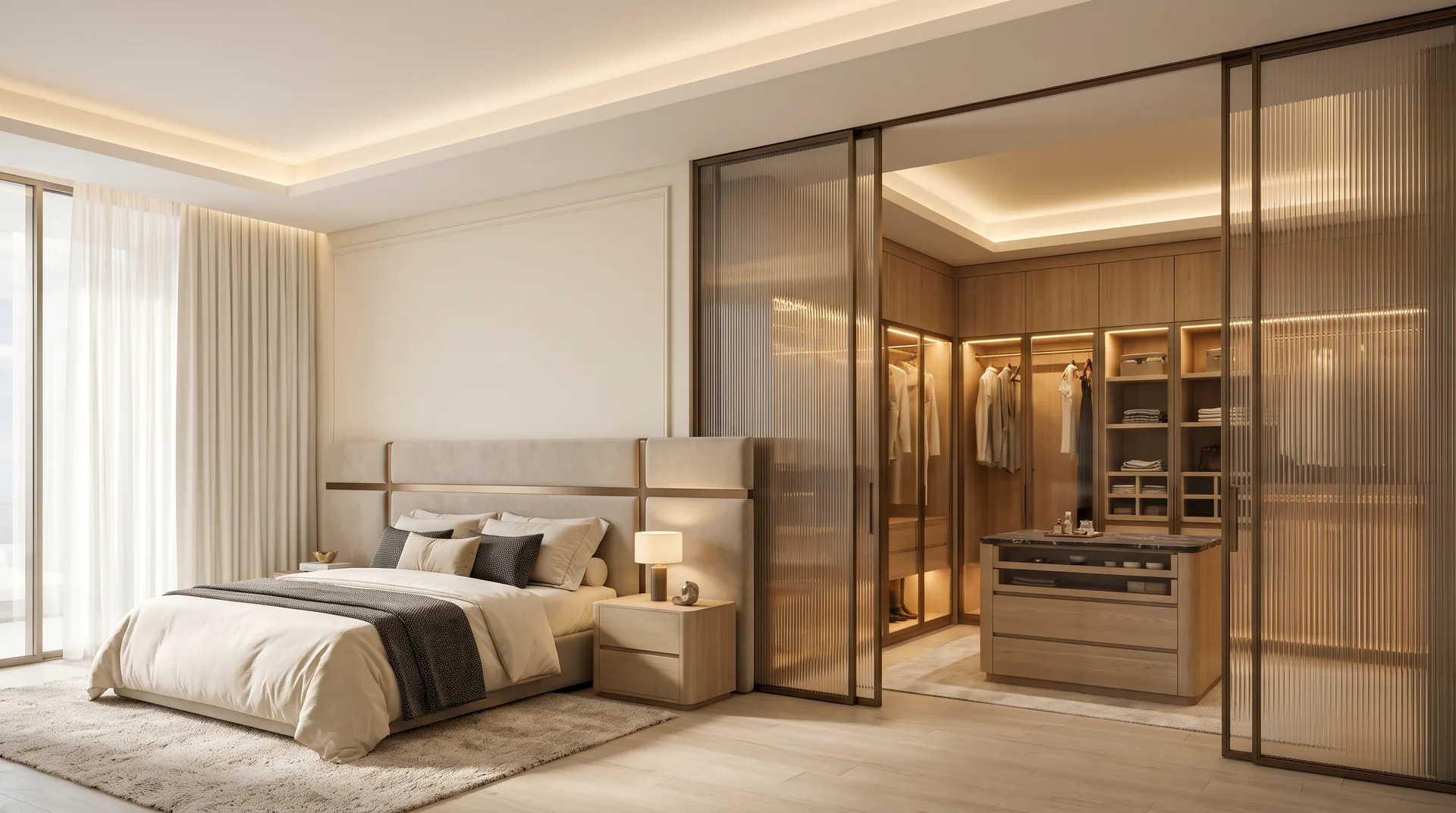
Fluted or reeded glass gives privacy while letting light through, and it has moved from bathrooms into dressing rooms, studies, kitchens and office meeting rooms. The same vertical rhythm appears in fluted joinery panels, bar counters, reception desks and wall cladding.
In the fit-out: fluted glass in slim bronze or black frames for partitions and sliding doors; fluted panels in timber veneer, MDF or stone for walls and counters. Cost effect: moderate; fluted glass costs more than clear glass, and fluted joinery takes more machining. Will it last? Fluted details are a strong current look; used in a few places rather than everywhere, they stay elegant.
Trend 4: Curves Everywhere
Curved ceilings, rounded wall corners, arched openings, curved reception desks and kitchen islands, and rounded furniture soften interiors and are popular in villas, apartments, restaurants and retail.
In the fit-out: curved gypsum ceilings and bulkheads with cove lighting, curved joinery made in the workshop, and careful setting-out on site. Cost effect: higher than straight work, because curved ceilings and joinery take more skill and time. Will it last? Gentle curves have been part of good design for a long time; very dramatic shapes are more of a statement.
Trend 5: Layered and Integrated Lighting
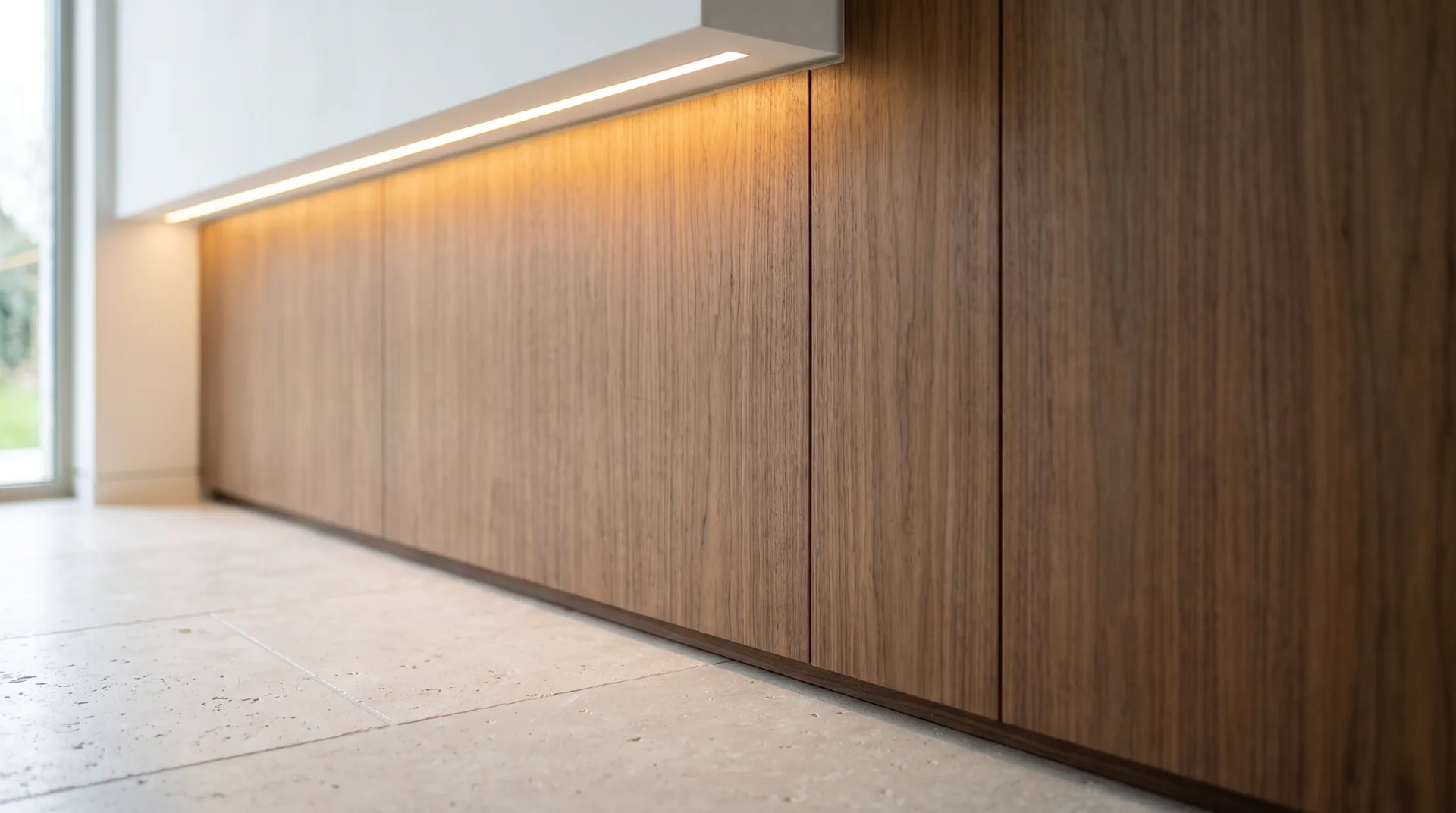
Lighting is now designed with the ceiling, not added afterwards. Cove lighting, linear lights, concealed strips in joinery and shelving, wall washers and a few decorative pendants replace grids of downlights.
In the fit-out: the ceiling design, the joinery and the electrical layout have to be drawn together, with separate circuits for each layer and dimming or control. Cost effect: moderate; the fittings can be simple, but the coordination matters. Will it last? Yes. Good, layered light makes any style look better and is the upgrade owners notice most. Our false ceiling page shows the ceiling details.
Trend 6: Limewash and Textured Plaster
Flat paint is being replaced on feature walls, and sometimes whole rooms, by limewash, textured plaster and microcement-style finishes that give soft movement and depth.
In the fit-out: these finishes need a well-prepared wall and skilled application, and they are applied near the end so they stay clean. Cost effect: higher than standard paint per m², but they are usually used on selected walls. Will it last? The look is popular now; as an accent rather than everywhere, it remains timeless. See our painting page for specialist finishes.
Trend 7: Full-Height Built-In Storage
Dubai homes are using full-height wardrobes, storage walls, media walls with closed cupboards, fitted entrance units and walk-in dressing rooms to keep rooms calm and clear.
In the fit-out: joinery is designed to the ceiling, with integrated lighting and handles, and fitted after floors and ceilings so it sits tight. Cost effect: joinery is often the largest single line in a premium fit-out, but it adds daily value. Will it last? Yes. Storage never goes out of fashion, especially in apartments. See our custom wardrobes page.
Trend 8: Smart Homes and Controls
Owners now expect strong Wi-Fi in every room, lighting scenes, AC zoning by room or floor, smart locks, video intercoms and, increasingly, electric car charging.
In the fit-out: data cabling and access points, separate lighting circuits, AC thermostats and zoning, and the power supply for chargers, all planned while ceilings and walls are open. Car chargers usually need DEWA approval. Cost effect: moderate to high, depending on the system, but much cheaper at fit-out than added later. Will it last? The infrastructure does; individual devices change, so cabling and good access are the long-term investment.
Trend 9: Acoustic Comfort
Hard stone floors, glass and open-plan layouts make interiors loud. Acoustic ceilings, wall panels, soft finishes, solid-core doors and, in towers, acoustic underlay under hard floors are becoming standard.
In the fit-out: acoustic insulation in partitions, acoustic ceilings in offices and restaurants, and careful detailing at doors and glass. Cost effect: modest when planned; expensive to retrofit. Will it last? Yes. A quiet space is a better space, at home and at work.
Trend 10: Wellbeing and Healthier Interiors
Daylight, fresh air, plants, natural materials and low-odour paints and adhesives are part of most briefs, for homes, offices and clinics alike.
In the fit-out: layouts that keep daylight deep in the space, glass partitions instead of solid walls where possible, fresh-air design with the AC, and healthier finishes. Cost effect: small; it is mostly about good choices. Will it last? Yes.
Trend 11: Hybrid Offices
Offices are being fitted out for teams that are not all there every day: fewer fixed desks, more small meeting rooms, phone booths, project spaces, breakout areas and a better pantry, with strong power and data everywhere.
In the fit-out: more enclosed rooms, more AC and lighting zones, acoustic glass and good booking-friendly meeting rooms. Cost effect: more rooms and glass cost more per sq ft, but the office can often be smaller. See our office fit-out page. Will it last? Flexible layouts with demountable glass partitions are the safest investment.
Trend 12: Experiential Retail and Open Kitchens
Shops are becoming places to try, meet and spend time, with lounge areas, better fitting rooms and lighting that changes with campaigns. Restaurants are opening up their kitchens and bars so the cooking becomes part of the experience.
In the fit-out: flexible display systems and lighting tracks in shops; open kitchens need careful exhaust, fire suppression, finishes and approvals. Cost effect: higher, especially for open kitchens. See our retail and restaurant fit-out pages. Will it last? The idea of experience is here to stay; specific looks change by brand.
Trends Compared: Cost and Staying Power
| Trend | Typical cost effect | Best planned at fit-out? | Staying power |
|---|---|---|---|
| Warm minimalism | Moderate (precision) | Yes | High |
| Travertine and natural stone | Higher | Yes | High |
| Fluted glass and joinery | Moderate | Yes | Medium to high |
| Curves | Higher | Yes | Medium to high |
| Layered lighting | Moderate | Yes | High |
| Limewash and textured plaster | Higher per m² | Partly | Medium |
| Full-height storage | High but valuable | Yes | High |
| Smart home and controls | Moderate to high | Yes | High (cabling) |
| Acoustic comfort | Modest when planned | Yes | High |
| Wellbeing | Small | Yes | High |
| Hybrid offices | Moderate | Yes | High |
| Experiential retail and open kitchens | Higher | Yes | Medium to high |
Trends by Type of Space
Villas and townhouses. Travertine and stone, double-height feature walls, curved ceilings with cove lighting, glass balustrades, dressing rooms and full-height storage, smart-home systems and covered terraces turned into usable rooms. See our villa and townhouse fit-out page.
Apartments and penthouses. Warm minimal interiors, one continuous floor finish, layered lighting, media walls with hidden storage, fluted glass partitions for studies and sleeping areas, and durable finishes for rentals. See our apartment and penthouse fit-out page.
Offices. Hybrid layouts, acoustic meeting rooms and phone booths, warm materials instead of corporate grey, better pantries and breakout areas.
Shops and restaurants. Experience-led layouts, flexible lighting, natural materials, open kitchens and bars, and terraces that work for more of the year.
Colours and Materials for 2026
The palette in Dubai fit-outs has settled around warm, natural tones that work with the strong light: ivory and off-white walls, sand and limestone floors, travertine, light oak and walnut joinery, and small amounts of bronze, brushed brass or matt black. Deep greens, terracotta and warm greys appear as accents on a single wall, a joinery front or upholstery.
The materials that go with this palette are matt rather than gloss: honed stone, matt porcelain, oiled or lacquered wood with a soft sheen, textured plaster and linen-look fabrics. They hide fingerprints and dust better than gloss and feel calmer in bright rooms.
What Is Going Out
A few looks from recent years are giving way:
- High-gloss everything. Gloss kitchens and floors show every mark in Dubai's light; matt and satin finishes are replacing them.
- Cool grey and white schemes. Replaced by warmer neutrals and natural materials.
- Grids of downlights. Replaced by layered, concealed and linear lighting.
- Open shelving everywhere. Replaced by closed, full-height storage with a few lit display niches.
- Busy feature walls. Replaced by one calm material used well, such as travertine or textured plaster.
Sustainable Fit-Out Choices
Sustainability in a fit-out is mostly about lasting longer and using less energy: LED lighting with sensors and dimming, AC zoning that only cools the rooms in use, good insulation in new partitions, low-odour paints and adhesives, and durable materials that will not need replacing in a few years. Reusing what works, such as a sound ceiling grid or existing joinery in a second-hand office or shop, also saves cost and waste. These choices are easy to make at the fit-out stage and they reduce running costs every month after.
Trends for Rental and Investment Properties
If the property is an investment, trends should help it let quickly and stay in good condition between tenants. The best choices are durable and broadly appealing: warm neutral walls, porcelain or SPC floors rather than delicate wood, good layered lighting, generous built-in storage, modern taps and fittings, and a kitchen and bathrooms that photograph well. Strong statement finishes are better left to the owner's own home, where they can be enjoyed for longer.
Bringing Trends Into an Existing Home
If your home is already finished, you do not need a full fit-out to bring in some of these looks. New lighting, a travertine or fluted feature wall, a fluted glass partition, new wardrobe fronts or a limewash finish can each be done room by room. For larger changes in a lived-in home, our home renovation page explains how we phase the work around you.
Trends for Different Budgets
You do not need a premium budget to use these ideas. Each level of fit-out can include the trends that give the most for the money.
Developer-finish upgrade (about AED 150–300 per sq ft). Focus on layered lighting and a stepped ceiling in the main rooms, full-height wardrobes, one continuous floor finish and a single feature wall in travertine-look porcelain or limewash. These change how the whole home feels without touching the kitchen and bathrooms.
Full mid-range fit-out (about AED 300–600 per sq ft). Add a new kitchen with an island and tall units, bathrooms with large-format tiles and fluted glass screens, a media wall, a dressing room and smart lighting control.
Premium and bespoke (about AED 600–1,200+ per sq ft). Natural stone floors and walls, curved ceilings and joinery, full smart-home systems, acoustic detailing and bespoke furniture.
For offices, shops and restaurants, the same rule applies: spend on what people see and use every day, such as reception, lighting, meeting rooms, display and the dining room, and keep back-of-house areas simple and durable.
Trends That Suit Dubai’s Climate
Some materials and details handle Dubai’s heat, light and dust better than others. Matt stone and porcelain hide dust and fingerprints; large-format tiles mean fewer grout lines to clean; engineered wood is more stable than solid wood in dry, air-conditioned rooms; and washable paints cope with the AC and humidity. Window treatments that diffuse strong sunlight, such as sheer curtains or blinds in recessed pockets, protect finishes from fading. Choosing trends with the climate in mind keeps a fit-out looking new for longer. Ask to see samples of stone, wood and paint in the actual room, at different times of day, before ordering, because Dubai’s bright light can make a warm sample look cold or a soft colour look washed out.
How to Use Trends Without Regretting Them
- Put trends in the details, not the structure. A fluted panel or a limewash wall is easy to change; a stone floor through the whole villa is not.
- Choose timeless bases. Calm floors, good ceilings and generous storage outlast any style.
- Spend on light. Lighting changes how every finish looks.
- Plan the services first. Smart controls, AC zoning and data are hard to add later.
- See samples in daylight. Dubai's bright light changes how stone, paint and wood look.
- Think about maintenance. Matt and textured finishes need different cleaning from gloss; stone needs sealing.
Planning a Trend-Led Fit-Out
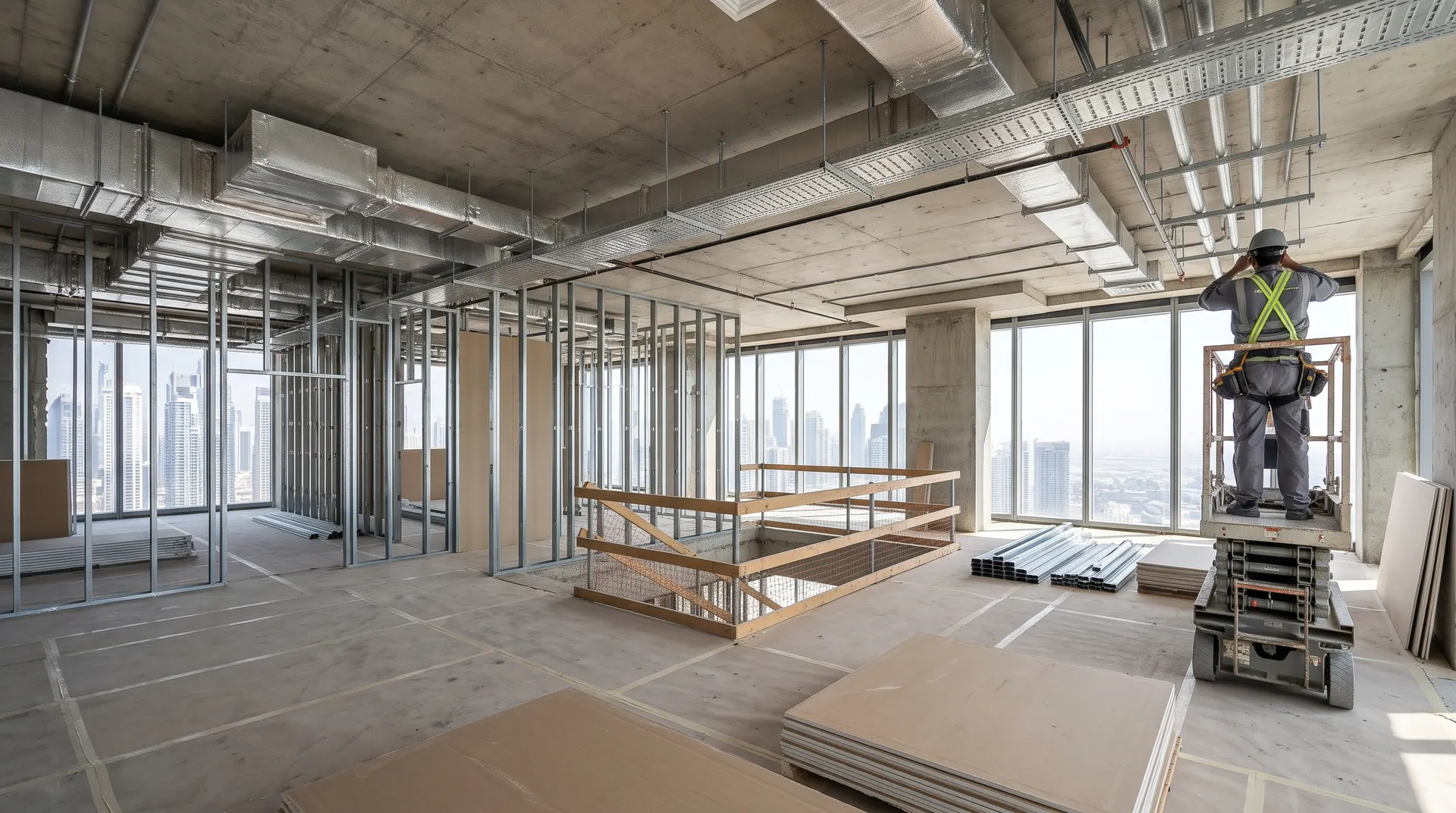
The best time to use any of these trends is at the fit-out stage, when ceilings, walls and services are open and every trade can work in order. Tell us which looks you like, send a few reference images and your floor plan, and we will show you how they fit your space and your budget. Start from our interior fit-out page, see typical prices in our fit-out cost guide, or read what interior fit-out includes.